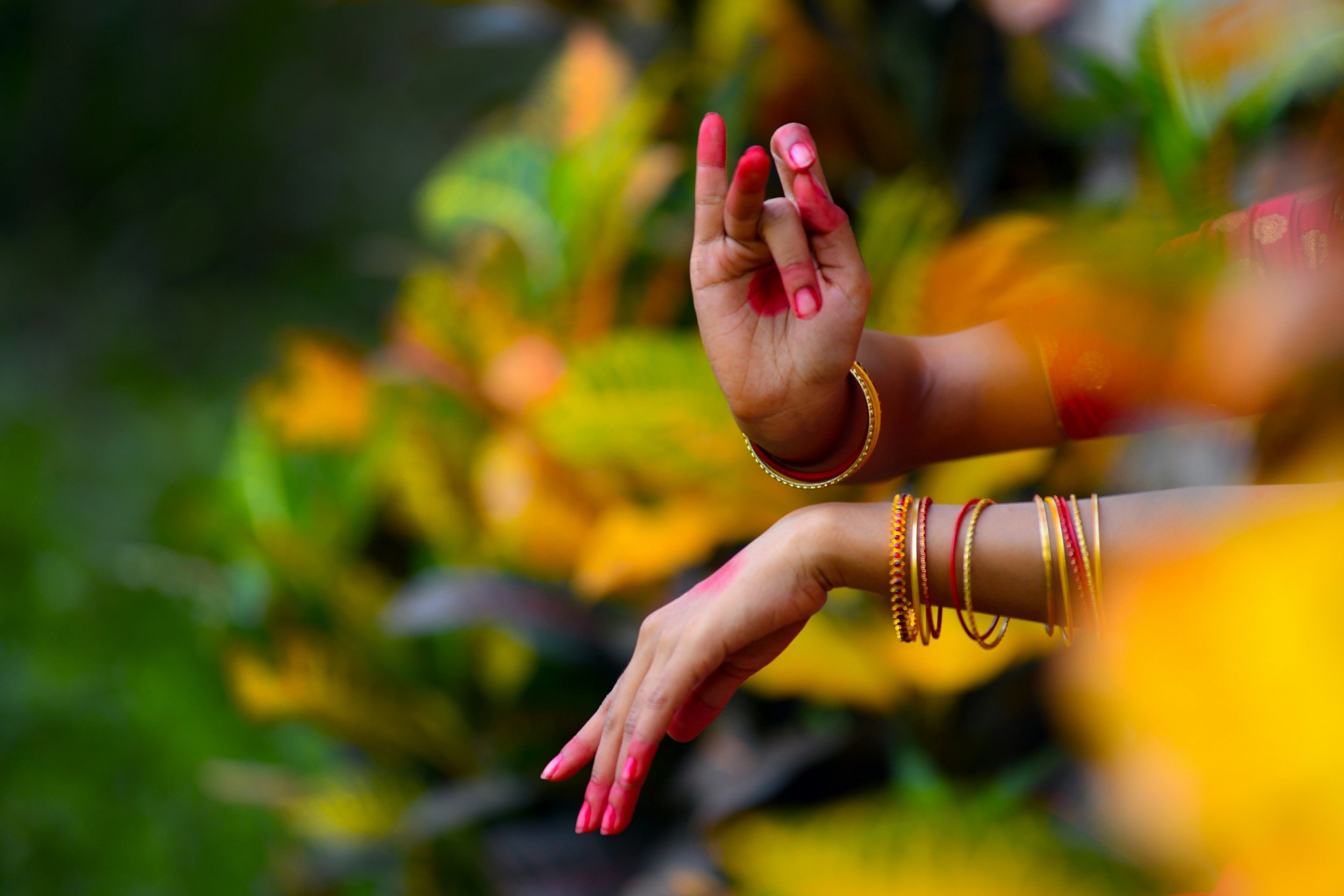
About Bharata Natyam
What is it?
A modern dance form with ancient roots.
The seeds which eventually became Bharata Natyam took root centuries ago, well before the English colonized India.
Back then, there were female dancers assigned to dance in Hindu temples in southern India. There is a great deal of debate and discussion now about the system that placed young women, known as devadasis, into that position, and that is something I am simply not educated enough to talk intelligently about now. Suffice it to say, the dance form these dancers once practiced was known as dasi aatam. The dancers were considered to be married to the presiding deity of the temples in which they danced. So dancers in a temple devoted to Shiva were consorts of Shiva. Dancers in a temple devoted to Vishnu were his consorts. And so on and so on. Remnants of this are visible in places like Chidambaram Nataraja temple in Tamil Nadu, in which there are sculptures of 108 karanas, or poses, in the side of the temple.
At some point, these temples came under the control of rulers from the Maratha empire in western India. The Marathas had the dancers perform in their courts, and the name of the dance became sadir aatam, which derives from the Marathi word connoting presentation and the Tamil word for dance.
Then came the British. With their arrival in India the 1700’s, the dance form was forced underground, because its performance was ridiculed and considered unfit for public consumption by the colonizers. The British outlawed temple dancing in 1910 and considered it indecent per Victorian standards.
But once the Indian independence movement began to pick up steam in the mid-20th century, there were several champions to bring it back to the forefront in its new and modern form, Bharata Natyam. Chief among them was Smt. Rukmini Devi Arundale, the renowned founder of the dance school called Kalakshetra (where my first teacher, Bindu Sundaram, studied).
Another figure who helped to revolutionize the dance form we now know as Bharata Natyam is someone directly in my lineage of teachers. And that is Smt. Kalanidhi Narayanan, or as she was known to her students — “Mami.”
Kalanidhi Mami is the one who taught my acharya (teacher), Smt. Ramya Harishankar, the intricacies of abhinaya—or creative expression/communication—for which Ramya Aunty is now very well known. Abhinaya is absolutely critical to our style of Bharata Natyam, known as the Vazhavoor style. This style was developed by esteemed teacher Vazhavoor B. Ramaiah Pillai. Vazhavoor Bharata Natyam is characterized by its emphasis on fluidity and grace in execution of the movements, as well as abhinaya and nuanced storytelling.
What does the word Bharata Natyam mean?
The exact meaning is unclear, but most who have looked into the etymology of the term interpret it in one of two ways.
In both interpretations, the second word, “natyam,” has the same meaning. In Sanskrit, natyam refers not just to the act of dancing, but also the broader art of conveying emotion and storytelling through movement and performance.
The difference between the two interpretations is in the meaning given to the first word, “Bharata.”
In the first interpretation, the word Bharata is considered an amalgamation of three ideas: (1) “bha” for “bhava,” (2) “ra” for “raagam,” and (3) “ta” for “taalam.”
Bhava is the emotion being communicated. There are many types of bhava that a dancer might use or show, based on the theme of a given piece — love, jealousy, fear, compassion are but a few examples. The list goes on and on. Bhava is a crucial method by which a dancer connects with the audience.
Raagam refers to the music to which the piece is set. Bharata Natyam is typically set to Carnatic music, a South Indian classical music form. There is a great deal of complexity within Carnatic music in terms of patterns and structure. Though it is not necessary to fully grasp Carnatic music theory in order to dance, some understanding of the patterns and counting is a must. Every song has a raagam, or a note pattern, that it follows. (And keep in mind, there are 72 foundational raagams in Carnatic music with literally hundreds of derivative ones.)
Taalam is the rhythmic cycle of a piece to which the dancer moves. The taalam must be played for us to dance Bharata Natyam. More often than not, we get it from one of two places. Either it’s the rhythm being hit by our teacher using fiberglass or wooden sticks or small cymbals (and spoken by him or her)—the rhythm given in this way is called nattuvangam.
Or it’s the percussionist in the musical ensemble that is accompanying — most often the percussion instrument is the mridangam. The mridangam is a cylindrical drum which is laid crosswise in front of the drummer and hit on the ends with bare hands. In order to dance with precision, a keen grasp of rhythm is an absolute must. You have to be able to hear the rhythm and follow it, or you just can’t dance.
So in the first interpretation, the “Bharata” in Bharatanatyam is a combination of bhava, raagam, and taalam.
The second interpretation of the meaning of “Bharata Natyam” is that it pays homage to the ancient Hindu sage and scholar Bharata, who is credited with composing the seminal Indian work on performing arts, the Natya Shastra, somewhere between 500 BCE and 500 CE.
Whichever way you interpret the term, Bharata Natyam is so much more than merely a dance form. It is an art form that aims to impart upon the audience story, character, emotion, and thought; and in turn, imbue the audience with a sense of awe and wonder, and contemplative reflection.
That is my goal.